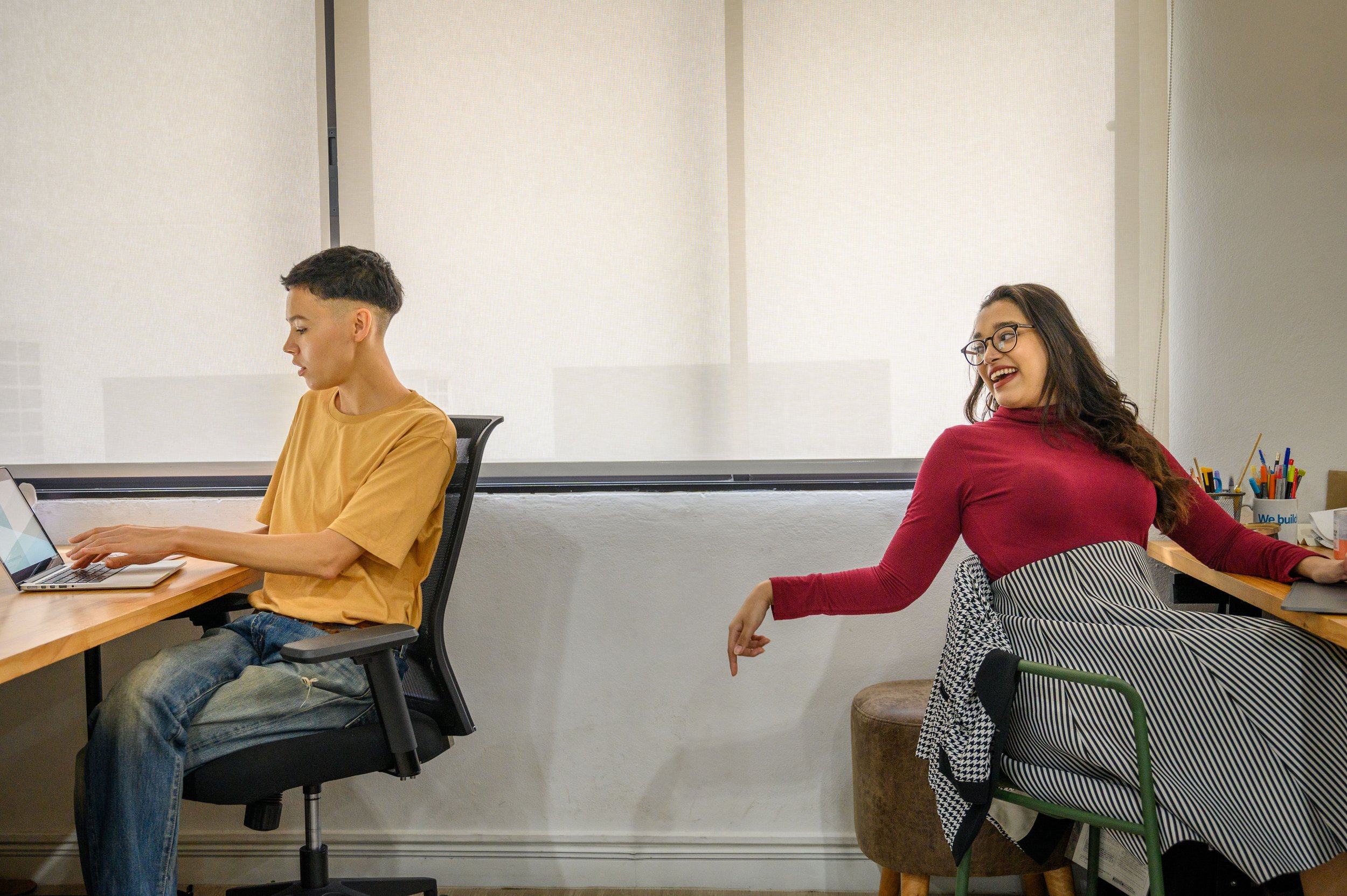
This one is for the work besties.
The person you message during a meeting:
Are you fucking hearing this?
The person who takes one look at your face when you walk into the office and says:
Oh no. What happened?
The person who knows exactly why an email containing the apparently innocuous words “Just following up...” has sent you into a rage.
The person you debrief with in the car park.
The person who saves you a seat.
The person who brings you coffee because they know you've had back-to-back meetings all morning.
The person you can catch eyes with across a meeting room and have an entire conversation without moving your face.
Your person at work.
If you've ever had one, you'll know something that psychologists have been telling us for years:
The people we work with can fundamentally change how work feels.
Sometimes the best thing about your job isn't the job
We spend an extraordinary amount of our lives at work.
And yet when we talk about whether a job is “good”, we tend to talk about things like salary, flexibility, career progression, workload and benefits.
Those things absolutely matter.
But there's another question that's probably just as important:
Do I have people here?
Humans have a fundamental need for belonging.
We want to feel that there are people around us who know us, understand us and notice when we're not okay.
Having that at work can make an enormous difference.
A shitty day when you feel completely alone is one thing.
A shitty day when you can walk over to someone's desk and say:
You're not going to fucking believe what just happened.
is somehow a different shitty day.
The problem hasn't necessarily changed.
But you're not carrying it alone anymore.
“Did you see that too?”
One of the most underrated things another person can give us is a shared reality.
Something weird happens in a meeting.
Your manager makes a completely contradictory decision.
Someone responds strangely to something you've said.
And your brain immediately starts trying to work out:
Was that weird?
Did I misunderstand?
Am I overreacting?
Then you look across the table.
Your work bestie raises one eyebrow.
Thank Christ.
They saw it too.
That tiny moment matters.
Shared reality is essentially the experience of feeling that somebody else understands or sees the world in a similar way to you.
It helps us make sense of our experiences.
Sometimes another person doesn't need to fix anything.
They just need to say:
“Yep. That was fucking weird.”
And suddenly you feel slightly more grounded.
We regulate each other more than we realise
There's another reason good workplace relationships can be so powerful.
Human beings don't regulate emotions entirely by ourselves.
We co-regulate.
Being around someone who feels safe can help our nervous system settle.
Think about the difference between walking out of a horrible meeting alone and walking out beside someone you trust.
You get back to your desks.
There's a pause.
Then one of you says:
Well. That was a fucking disaster.
And you both start laughing.
The meeting hasn't changed.
The workload hasn't changed.
Craig from Business Development is still presumably out there promising clients things that aren't technically possible.
But something in you has shifted.
You've shared the experience.
You've discharged some of the tension.
And you've been reminded:
I'm not dealing with this place entirely by myself.
Work friendships can make us more resilient, without asking us to tolerate bullshit
I sometimes have mixed feelings about the word resilience in workplaces.
Too often it gets used to mean:
We're not going to fix the systemic problem, so here's a lunchtime webinar about breathing.
That's not what I'm talking about.
Social support is a genuine psychological resource.
Having people we trust can buffer some of the effects of stress.
They can give us perspective when we're catastrophising.
They can remind us what we're good at when our confidence has taken a hit.
They can make us laugh on an objectively terrible Tuesday.
They can tell us when we're being unreasonable.
And, importantly, they can tell us when we're not.
Sometimes your work bestie says:
Mate, let it go. You're tired and you're reading too much into this.
Other times they say:
No. That's not okay. You need to do something about that.
Both are valuable.
A good ally doesn't just agree with everything you say.
They help you find your bearings.
Your work bestie is also allowed to tell you when you're being a dickhead
This might actually be one of the most important parts of a good work friendship.
Your work bestie isn't just there to validate every complaint you make about everyone else.
Sometimes you're the one who's had a bad day.
Sometimes you were unnecessarily defensive in the meeting.
Sometimes that email really wasn't passive-aggressive.
Sometimes you've been talking about the same workplace injustice for three days and your work bestie is ready to stage an intervention.
Good relationships give us psychological safety, but psychological safety doesn't mean nobody ever challenges us.
It means there's enough trust in the relationship that someone can say:
I love you, but I think you might be the dickhead in this particular situation.
And you know they're saying it because they're in your corner.
That's valuable too.
Then somebody leaves
And this is when you realise just how important the relationship had become.
Your work bestie gets another job.
They transfer departments.
They go on parental leave.
The team gets restructured.
And suddenly you're sitting in exactly the same workplace thinking:
Why does this place feel completely different?
Nothing about the actual job has changed.
Same desk.
Same workload.
Same manager.
Same Craig.
But your person isn't there.
And sometimes that's when we realise that a significant part of what made the job tolerable, or even enjoyable, wasn't the job at all.
It was who we were doing it with.
That's a real loss.
We shouldn't dismiss it because they were “just someone from work”.
When you spend forty hours a week with someone, share hundreds of tiny daily interactions, survive stressful periods together and know far too much about each other's lives, that relationship matters.
And sometimes those relationships don't end when the job does.
The person who started out sitting two desks away becomes someone who's at your wedding.
Someone who knows your kids.
Someone you're still sending inappropriate memes to ten years after either of you worked there.
Work is where a lot of adult friendships begin.
And that's actually pretty bloody lovely.
If you've got a work bestie, appreciate them
You don't need to make it weird.
You don't need to organise a ceremony in the break room and exchange friendship vows beside the photocopier.
Just notice what you've got.
Send them the stupid meme.
Buy them the coffee occasionally.
Check in when they're having a rough week.
Celebrate when something goes well for them.
Tell them when they've done good work.
Be the person who notices when they're unusually quiet.
And maybe, every now and then, actually tell them:
“You make this place significantly less shit.”
Because workplaces are made up of policies and KPIs and org charts and strategic plans and systems and processes.
But they're also made up of relationships.
And sometimes the reason we survive a difficult job, enjoy a good one, or stay somewhere much longer than we expected has very little to do with the work itself.
Sometimes it's because somewhere between the Monday morning meeting and the Friday afternoon “fuck this, I'm going home”, we found our person.
And work was better because they were there.
So, to the work besties, the allies, the confidantes, the coffee-bringers, the eye-contact-across-the-meeting-table people, and the people we absolutely would not have survived that restructure without:
Thank you for making work less shit.
Send this to your work bestie.