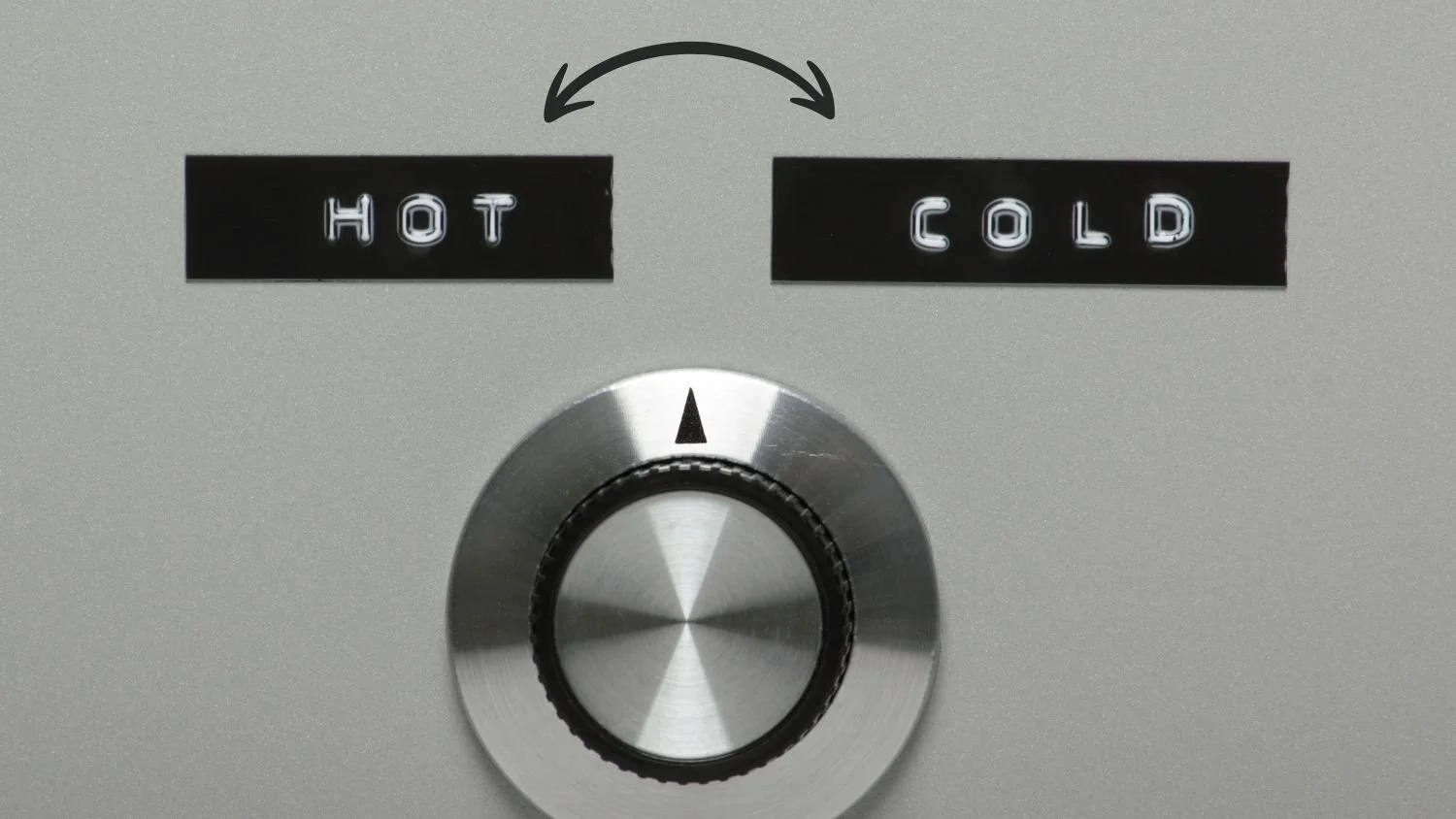
One day your boss is chatting away to you, asking about your weekend, laughing at your jokes and treating you like you're practically mates.
The next day?
Barely a hello.
They're short with you. Everything is business. They walk past without acknowledging you and suddenly you're wondering:
Did I do something?
Are they annoyed with me?
Was I too familiar yesterday?
Am I about to get hauled into a meeting?
Welcome to the strange psychological experience of having a hot-and-cold boss.
The frustrating thing is that your boss might not even realise they're doing it. Their behaviour could be affected by stress, workload, personality, who else is around or a hundred other things you know absolutely nothing about.
But that doesn't mean the inconsistency doesn't affect you.
Because when someone's behaviour towards us becomes unpredictable, our brains tend to pay more attention to it.
Why does an unpredictable boss get inside your head?
Human beings really like predictability.
We constantly make predictions about the people around us.
If I do X, they'll probably do Y.
Most of the time, we don't even notice ourselves doing it.
But when somebody becomes unpredictable, our brain has a harder time knowing what to expect.
And when that unpredictable person happens to be your boss, it matters even more.
They aren't just Dave from Accounts having a weird Tuesday.
Your boss potentially has some control over your workload, performance feedback, opportunities, hours, income and continued employment.
So your brain pays attention.
You might start walking into work and immediately checking their mood.
They're quiet today.
They didn't say hello.
That email sounded a bit abrupt.
They were laughing with Sarah five minutes ago. Why are they weird with me?
Before long, you've accidentally acquired another workplace responsibility:
monitoring your boss's emotional weather.
And unfortunately, nobody is paying you for it.
The intermittent reinforcement problem
There's another psychological process that can make this dynamic surprisingly powerful.
It's called intermittent reinforcement.
Basically, rewards can become particularly compelling when they're unpredictable.
If your boss was cold and distant all the time, you'd probably eventually think:
Right. That's just what they're like.
But if they're sometimes warm, encouraging and interested in you, and sometimes distant or dismissive, your brain doesn't get that certainty.
So you keep looking for the warm version.
When they suddenly become friendly again, there's a little sense of relief.
Oh good. We're okay.
Then they're cold again.
Shit. What happened?
This doesn't necessarily mean your boss is deliberately manipulating you. They might simply be inconsistent.
But your brain can still get caught in the pattern.
And that's why one of the most useful things you can do is stop making their emotional temperature your responsibility.
Stop trying to crack the code
When someone behaves inconsistently towards us, it's very tempting to start analysing why.
Maybe I talked too much yesterday.
Maybe they didn't like that suggestion I made.
Maybe I should have replied to that email sooner.
Maybe they like Sarah more than me.
Maybe I'm annoying.
The problem is that you're trying to solve a puzzle without having all the pieces.
Psychologists call this kind of explanation-making attribution. We naturally try to work out why people behave the way they do.
And when we're anxious or uncertain, we can be particularly prone to making internal attributions:
They are behaving differently because of something I did.
Maybe.
But there are dozens of other possibilities.
They could be stressed. Distracted. Tired. Under pressure from their own boss. Dealing with something outside work. Trying to appear more formal because somebody senior is around.
Or perhaps they're simply a bit inconsistent.
You don't actually know.
And endlessly trying to figure it out rarely gives you the certainty you're looking for.
Pick your own temperature
One of the most useful responses to an inconsistent boss is surprisingly boring.
Be consistent yourself.
You don't need to match their energy.
When they're incredibly friendly, you don't have to suddenly become their best mate.
When they're cold, you don't have to withdraw, panic or desperately try to win them back.
Pick your own temperature.
Friendly.
Professional.
Polite.
Appropriately boundaried.
And stay roughly there.
If they're chatty today, great.
If they're distant tomorrow, okay.
You're no longer adjusting yourself every time the emotional weather changes.
That consistency gives you something important: your own psychological anchor.
Be careful how much meaning you give the cold days
This doesn't mean ignoring genuine problems.
If your boss tells you there's an issue with your performance, take that information seriously.
If their behaviour becomes bullying, intimidating, discriminatory or inappropriate, that's a different problem and may need to be addressed formally.
But a change in someone's mood is not the same thing as feedback.
Your boss being quiet isn't a performance review.
An abrupt email isn't necessarily evidence that your job is in danger.
And them being more talkative with somebody else doesn't automatically mean they dislike you.
When you notice yourself trying to interpret their behaviour, ask:
What do I actually know here, and what am I filling in?
Sometimes the answer will be:
I know they're being a bit weird today.
Everything after that might be a story your anxious brain is writing because it doesn't like uncertainty.
You don't need to manage your boss's mood
Working with an unpredictable manager can be exhausting because you can slowly start organising your own behaviour around theirs.
When they're warm, you relax.
When they're cold, you worry.
When they're friendly again, you feel relieved.
And suddenly your sense of whether you're doing okay at work is being determined by whatever mood your boss happens to be in that morning.
Try to bring your attention back to more reliable information.
Are you doing your job?
Are you meeting reasonable expectations?
Have you actually received negative feedback?
Is there a concrete problem that needs addressing?
If there is, deal with the problem.
If there isn't, you probably don't need to spend the rest of Tuesday trying to work out why your boss didn't say hello in the kitchen.
Their mood belongs to them.
You already have a job.
You don't need another one monitoring it.
Is work getting inside your head?
I've put together The Workday Rescue Mini Guide... a free, practical guide with psychological tools to help you manage difficult workdays, workplace anxiety and all the thinking about work that tends to follow you home.